Summary:
You’re looking at propane for your Suffolk County home and trying to figure out what you’ll actually spend to get everything installed and running. The numbers online are all over the place. One site says $800, another says $5,000, and you’re left wondering what applies to your situation.
Gas line installation cost depends on distance from your tank to the house, the complexity of the route, tank size, and whether you’re going underground or above ground. In 2026, most Suffolk County homeowners spend between $1,500 and $4,500 for a complete propane tank and gas line installation, but your specific property and needs will determine where you land in that range. Here’s what actually shapes that number.
Gas Line Installation Cost Breakdown for Propane Systems
Gas line installation from your propane tank to your house runs $15 to $50 per linear foot in 2026, with most Suffolk County installations averaging $20 to $40 per foot when you factor in materials and labor. That’s just the line itself.
Your total project cost includes the tank, excavation if you’re going underground, the gas lines running to your home and appliances, permits, pressure testing, and inspection fees. A straightforward installation with a 500-gallon tank placed 30 feet from your house might cost $2,500 to $3,500 total. Add difficult terrain, multiple appliances, or a longer run, and you’re looking at $4,000 to $6,000 or more.
The biggest variable is complexity. A simple, straight run with easy access costs significantly less than installations requiring multiple bends, navigating around obstacles, going through walls, or running lines to several connection points inside your home.

What Actually Drives Your Gas Line Installation Cost Higher
Distance matters more than almost anything else. If your tank sits 20 feet from your house, you’re paying for 20 feet of pipe, fittings, and labor. Move that tank to 80 feet away—maybe to meet setback requirements or because that’s the only spot that works on your property—and your material and labor costs nearly quadruple.
Terrain and accessibility come next. Flat, open ground with no obstacles means faster, cleaner installation. Rocky soil, tree roots, existing utilities, driveways, or landscaping you want to preserve all add time and complexity. In Suffolk County, many properties have mature landscaping or hardscaping that needs careful work-arounds, which increases labor hours.
The number of appliances you’re connecting affects cost too. Running a single line to a furnace is straightforward. Adding connections for a water heater, stove, dryer, fireplace, and pool heater means more pipe, more fittings, more shut-off valves, and more labor. Each appliance needs its own properly sized connection and safety valve.
Pipe material also plays a role. Flexible corrugated stainless steel tubing costs $2 to $4 per linear foot and installs faster than rigid black iron pipe at $3 to $8 per foot. Underground runs typically use polyethylene pipe at $0.50 to $1.50 per foot for low-pressure sections, but you’ll still need rigid piping for certain connections and transitions.
Suffolk County’s coastal environment adds another consideration. Salt air accelerates corrosion on metal components, so proper coatings and materials matter more here than in other regions. We know which materials hold up in local conditions and how to protect your system long-term. Cutting corners on materials might save money upfront but leads to expensive repairs or replacements within a few years.
Permits and inspections aren’t optional in Suffolk County. Expect to pay $100 to $300 for permits, and your installation must pass inspection before you can use your system. Pressure testing runs $75 to $150 for standard tests, though some jurisdictions require extended 12- or 24-hour tests that can cost up to $500. These aren’t add-ons we’re padding the bill with—they’re required by local code and NFPA 58 safety standards.
Gas Line Installation Cost by Project Type
New installations from street or tank to house represent the highest cost because you’re starting from scratch. Running a new gas line from a propane tank to your home typically costs $800 to $3,000 for most residential projects. That includes the line from the tank, connections to your main distribution point, and basic hookups to one or two appliances.
If you’re extending an existing gas line to add an appliance, costs drop significantly. Extensions run $10 to $20 per linear foot since you’re working with a smaller pipe and shorter distance. Adding a line for a new gas stove or fireplace might only cost $300 to $800 if the existing system has capacity and the new appliance is relatively close to current lines.
Moving an existing gas line during a remodel costs $15 to $25 per linear foot. This happens when you’re reconfiguring your kitchen, relocating appliances, or changing from electric to gas in a different part of your home. The work involves safely capping the old line, running new pipe, and connecting everything properly.
Replacing old or damaged gas lines costs more—$23 to $35 per linear foot—because you’re paying for removal and disposal of the old line on top of new installation. If you have an older home with corroded pipes or you’re dealing with a leak, replacement becomes necessary for safety. The higher cost reflects the extra labor of removing old materials and ensuring the new system integrates properly with your existing setup.
For Suffolk County properties converting from oil to propane, you’re looking at a complete system installation. This includes the propane tank, all gas lines from tank to house, connections to your heating system and appliances, removal of old oil tank if needed, and all permits and inspections. Total costs typically range from $3,000 to $9,000 depending on property size, number of appliances, and whether you’re installing underground or above-ground tanks.
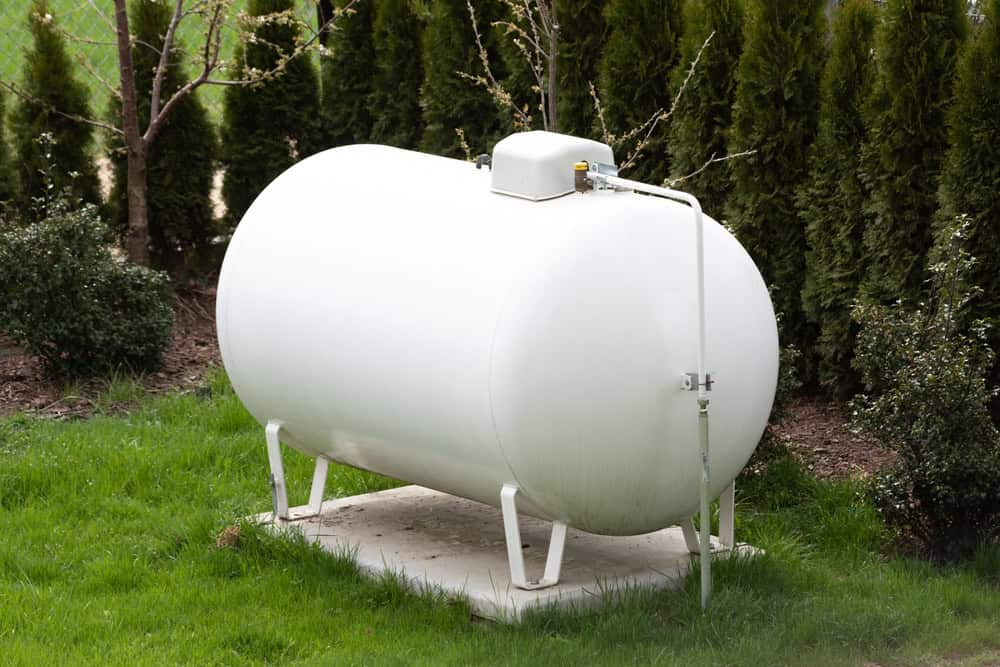
The type of tank you choose affects your gas line installation too. Underground tanks require excavation, which adds $1,000 to $2,500 to your project depending on soil conditions and depth requirements. Above-ground tanks sit on concrete pads that cost $50 to $175, making them less expensive to install initially. However, underground tanks offer better protection from Suffolk County’s coastal weather and temperature extremes, which can improve system efficiency and longevity.
Tank size matters for gas line installation because larger tanks often sit farther from your home to meet setback requirements. A 250-gallon tank might fit closer to your house, minimizing gas line length and cost. A 500-gallon or 1,000-gallon tank typically needs to be placed at least 10 feet from your home and property lines per NFPA 58 standards, which can mean longer, more expensive gas line runs.
Underground 250 Gallon Propane Tank Installation
An underground 250-gallon propane tank holds approximately 200 gallons when filled to the safe 80% capacity level. This size works well for smaller Suffolk County homes, vacation properties, or homes using propane for specific applications like hot water, a generator, or a pool heater rather than whole-house heating.
The tank itself measures about 7 feet 2 inches long and 31.5 inches in diameter. Installation requires burying it 10 to 12 inches below ground surface, with only a protective dome and lid visible above grade. Total installation cost for an underground 250-gallon tank typically runs $1,500 to $3,000, which includes the tank, excavation, anode bag for corrosion protection, dome, lid, and basic gas line connections.
Suffolk County’s regulations require professional installation that meets NFPA 58 standards. We apply for permits as the licensed installer—not the homeowner—and installation must pass inspection before use. This ensures proper depth, setback distances, corrosion protection, and safe connections.

When a 250 Gallon Underground Tank Makes Sense for Your Property
A 250-gallon underground propane tank fits specific use cases well, but it’s not the right choice for every property. Understanding when this size works helps you avoid undersizing your system and dealing with constant refills, or oversizing and paying for capacity you’ll never use.
Vacation homes and seasonal properties are ideal candidates. If you’re heating a Hamptons vacation home only during summer months or winter weekends, a 250-gallon tank provides enough capacity without the expense of a larger system. You’re not maintaining year-round heat, so your consumption stays manageable.
Homes using propane for supplemental purposes rather than primary heating also benefit from this size. Maybe you have electric or oil heat but want propane for your water heater, fireplace, and outdoor grill. Or you’re running a backup generator that only operates during power outages. These applications don’t require the capacity of a 500-gallon or 1,000-gallon tank.
Properties around 2,000 square feet or smaller with limited propane appliances can work with a 250-gallon tank if they’re not using propane as the primary heating source. You might heat with oil or electric and use propane for cooking, hot water, and clothes drying. In this scenario, a 250-gallon tank refilled a few times per year handles your needs without oversizing.
Cost-conscious homeowners who want to minimize upfront investment sometimes start with a 250-gallon tank. The smaller tank costs less to purchase and install, and excavation requirements are less extensive than larger tanks. However, if your usage grows or you convert more appliances to propane later, you might find yourself refilling too frequently or needing to upgrade to a larger tank.
Suffolk County’s coastal environment makes underground installation particularly attractive for the 250-gallon size. The tank disappears from view, preserving your property’s aesthetics. It’s protected from temperature extremes and coastal weather. And because it’s smaller than 500-gallon or 1,000-gallon tanks, it’s easier to find suitable placement that meets setback requirements without consuming large portions of your yard.
Installation involves excavating a hole sized for the tank with proper clearances, placing 6 inches of pipe sand in the bottom for bedding, setting the tank, attaching an anode bag to protect against corrosion from ground moisture and electrical currents, connecting the copper wire from anode to tank, surrounding the tank with pipe sand (dirt must not touch the tank or excessive pitting occurs), and installing the dome and lid for access. The entire process typically takes one day from excavation to final hookup.
250 Gallon Tank Installation Costs and What's Included
The tank itself costs $600 to $1,200 for above-ground models and $1,500 to $3,000 for underground models when you include installation. The price difference reflects excavation labor, anode bag for corrosion protection, special underground coating, and additional installation complexity.
Excavation for a 250-gallon underground tank isn’t as extensive as larger tanks, but it still requires professional equipment. The hole needs to accommodate the tank’s 7-foot length plus clearances, with proper depth to ensure the top of the tank sits 10 to 12 inches below finished grade. In Suffolk County, soil conditions vary from sandy coastal areas to rockier inland terrain, which affects excavation difficulty and cost.
Gas line installation from your 250-gallon tank to your house adds $400 to $1,500 depending on distance and complexity. A tank placed 20 feet from your home with a straight, simple run costs far less than a tank 60 feet away requiring multiple bends or obstacles to navigate. Most installations include the main line to your house plus connections to one or two appliances in the base price.
Permits in Suffolk County run $100 to $300 for propane tank installation. We handle the permit application—regulations require the propane company to apply as the qualified installer, not the homeowner. Permit fees cover plan review and inspection to ensure your installation meets local code and NFPA 58 safety standards.
Pressure testing costs $75 to $150 for standard tests that check for leaks and verify proper system pressure. Some Suffolk County municipalities require extended testing periods, which can push costs to $500. This isn’t optional—your system can’t be used until it passes pressure testing and inspection.
Concrete dome and lid for underground tanks typically run $100 to $300 and provide access to the tank’s valves, gauges, and fill port while protecting them from weather and debris. The dome keeps everything secure and makes refills straightforward for delivery drivers.
Anode bags for corrosion protection cost $50 to $150 and are essential for underground tanks in Suffolk County. The coastal environment’s salt air and ground moisture accelerate corrosion on metal tanks. The anode bag acts as a sacrificial anode, absorbing electrical currents in the ground that would otherwise corrode your tank. This extends tank life significantly and prevents expensive early replacement.
Installation labor for a complete 250-gallon underground tank setup runs $500 to $1,500 depending on site conditions, excavation difficulty, gas line length, and number of appliance connections. Professional installation ensures proper depth, correct anode bag attachment, adequate pipe sand bedding and coverage, secure dome installation, and leak-free gas line connections.
Total project cost for a 250-gallon underground propane tank with gas lines to your home typically ranges from $2,000 to $4,500 in Suffolk County. That includes the tank, excavation, installation, anode bag, dome and lid, gas lines, permits, pressure testing, and inspection. Properties with challenging terrain, longer gas line runs, or multiple appliance connections will land on the higher end of that range.
500 Gallon Below Ground Propane Tank Installation
A 500-gallon below ground propane tank holds approximately 400 to 425 gallons at the safe 80% fill level. This is the most common residential propane tank size in Suffolk County because it handles whole-home heating plus multiple appliances without requiring constant refills.
The tank measures roughly 9 feet 10 inches long and 37.42 inches in diameter. It’s designed for homes between 2,500 and 4,500 square feet that use propane as their primary heating source along with water heating, cooking, clothes drying, and potentially pool heating or generators.
Installation costs for a 500-gallon below ground propane tank range from $2,500 to $4,500 in Suffolk County. That includes the tank ($1,800 to $3,000), excavation ($800 to $1,500), anode bag, dome and lid, gas line installation to your home, permits, pressure testing, and inspection.