Summary:
Ask how long a propane tank lasts and the honest answer is “it depends.” A tank that runs only a range and a water heater can go months between fills. The same tank feeding a furnace in January can drop by a quarter in a week or two.
That does not mean you have to guess. Once you know roughly how many gallons your home burns on a cold day, and how many usable gallons your tank actually holds, you can estimate how long a fill will carry you. This guide walks through the numbers for a typical Long Island winter, with a close look at homes that rely on propane service in Center Moriches.
How Propane Usage Is Measured
Propane is delivered by the gallon, but your appliances burn it by the BTU. One gallon of propane holds roughly 91,500 BTUs of heat energy, and that figure is the bridge between the two.
Every gas appliance has an input rating on its nameplate, given in BTUs per hour. A furnace rated at 80,000 BTUs per hour burns a little under a gallon for every hour its burner is actually firing. It does not fire all day, though. On a mild November afternoon it might run a few hours in total. On a windy January night it may cycle on for much of the night.
That is why usage is usually talked about in gallons per day or per month, and why the weather matters so much. Delivery companies track it with heating degree days, a running measure of how far the outdoor temperature falls below about 65 degrees. The colder the day, the more degree days it adds, and the more propane a heated home burns. Our overview of propane home heating services explains how the furnace fits into the rest of the system.
How Long Each Tank Size Lasts in Winter
Start with usable gallons, not the number on the tank. Tanks are rated by water capacity and filled to about 80 percent, so a 500 gallon tank holds around 400 gallons when full. Our LP tank sizes and capacity chart lists the figures for every common size. You also want to reorder at about 30 percent rather than run it down to empty. That leaves a working range smaller than the label suggests.
Next, a rough burn rate. For a year-round Long Island home that heats with propane, midwinter use often falls somewhere between 3 and 8 gallons a day, and it can reach 10 or more during a hard cold snap in a larger or draftier house. Those are general ranges, not a promise. Your own delivery history is the best guide, and these figures assume heat is the main load, with other appliances on top.
A 100 gallon tank holds about 80 gallons when full. It is common for a range, a water heater or a dryer, which together might use 15 to 40 gallons a month, so a fill can last two months or longer. Asked to run a furnace in January, the same tank could reach its reorder line in a week or two.
A 250 gallon tank holds about 200 gallons. At 3 to 8 gallons a day, that is roughly 25 to 65 days from full to empty, and noticeably less before it reaches 30 percent.
A 325 gallon tank holds about 260 gallons, which works out to roughly five to twelve weeks of midwinter heating on the same assumptions.
A 500 gallon tank holds about 400 gallons, anywhere from about seven weeks to four months of winter heat depending on the house. That margin is why it is the usual choice for whole-house heating. If your tank feels undersized, our propane tank installation team can talk through a larger one.
What Drives Your Burn Rate
Two homes with identical tanks can burn propane at very different rates. A handful of factors explain most of the gap.
The furnace or boiler is the big one. Heating usually accounts for most of a propane home’s winter use, and efficiency matters. An older 80 percent furnace turns about 80 cents of every fuel dollar into heat, while a high-efficiency model can reach 95 percent or more. A furnace that has not been serviced can also burn more than it should, which is one reason a yearly propane furnace tune-up pays off.
Next come the other appliances. A tank-type propane water heater might use roughly 15 to 30 gallons a month, depending on household size and how many showers get taken. A range typically uses a few gallons a month, and a dryer somewhere in between, depending on how many loads you run. A gas fireplace can burn half a gallon to a gallon an hour while it is on. Individually they are modest. On top of heat, they add up.
Then the house itself. Square footage, ceiling height, the age of the windows, attic insulation and air leaks around doors and sills all change how hard the furnace works. So does the thermostat. Each degree you set it lower over a long stretch trims the heating load a little, and a setback overnight helps more than most people expect.
Finally, the weather. A mild December and a bitter January can differ by a third or more in heating demand, and wind makes an exposed house lose heat faster. That is why a tank that lasted six weeks last winter may last four this year. On Long Island the heating season usually runs from October into April, and January and February tend to be the heaviest months.
Reading the Gauge: The 80 and 30 Percent Rules
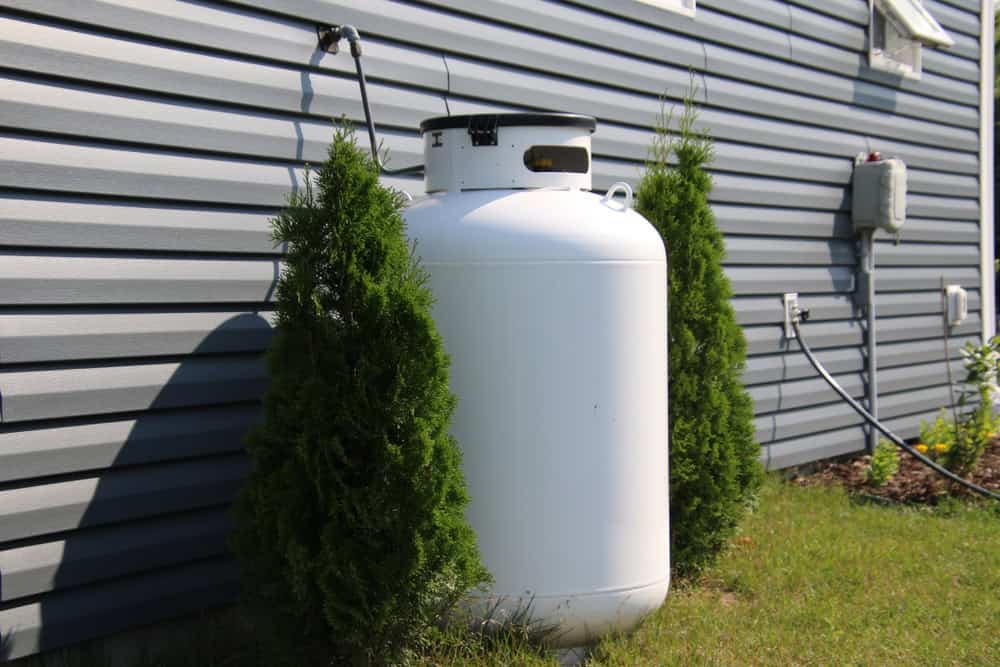
Most home tanks have a float gauge under the dome lid. It reads in percent of the tank’s capacity, not gallons, so the math is simple: multiply the reading by the tank size. A 500 gallon tank at 40 percent holds about 200 gallons.
A full tank reads about 80 percent, not 100. That is deliberate. Liquid propane expands as it warms, and the space at the top of the tank leaves room for that expansion. A reading near 80 after a delivery means the tank was filled correctly.
The other number to remember is 30 percent. That is the usual point to arrange your next propane delivery. It leaves enough in the tank to cover the time it takes to schedule a delivery, plus a cushion if the weather turns cold or a storm slows the roads. Below 20 percent in winter, you are cutting it close. Check the gauge weekly in January and February, and more often during a cold snap. If it reads the same week after week in cold weather, have it looked at. A float gauge can stick, and a wrong reading is worse than none.

Center Moriches Homes and the Winter Load
Center Moriches sits on the South Shore along Moriches Bay, and it mixes year-round households with second homes and waterfront places that stand empty for part of the year. That mix shapes how propane gets used. A house that is lived in through the winter runs its heat every day from late fall into spring, so its tank carries a full heating season. A second home that is closed up and winterized may burn very little until spring.
Many homes in the hamlet also run more than one appliance off the same tank. The furnace, the water heater, the range and sometimes a dryer or fireplace all draw from one supply. That is convenient, but it means a low tank affects everything at once. When it runs out, you lose hot water and cooking as well as heat, and after a run-out the system has to be leak checked and relit before it can be used safely.
The housing stock matters too. Center Moriches mixes older capes and ranches with newer and expanded homes, and an older house with original windows and thin attic insulation can burn noticeably more than a tighter house of the same size. If your home has gained an addition, a finished basement or a new gas appliance over the years, a tank sized for the original house may now be working harder than it was meant to.
Weather near the bay adds its own wrinkle. Wind off the water pulls heat out of exposed houses, and a nor’easter can slow the roads for a day or two. A clean, efficient furnace helps on the first count, and our page on furnace cleaning services covers what that involves. The simplest protection, though, is to keep the tank from getting low in the first place.
Automatic Delivery vs Will-Call
How often your tank gets refilled also depends on your delivery plan. With automatic delivery, the supplier forecasts your usage from the weather and schedules fills before the tank runs low, while with will-call you watch the gauge and call at about 30 percent. Our guide to automatic delivery vs will-call for Center Moriches homes compares the two in full, including which suits a year-round or seasonal house.
Keeping Your Tank Ahead of Winter
How long a propane tank lasts comes down to a few numbers you can find yourself: the tank’s size, the 80 percent full mark, the 30 percent reorder line and how many gallons your home burns on a cold day. Check your last few delivery tickets to see how much you used between fills, and note the dates. That history, set against the weather, is the most accurate forecast you will get. A single winter of tickets tells you more about your home than any rule of thumb, including the ranges in this guide.
Before winter settles in, top up the tank, get the furnace serviced and decide whether automatic delivery or will-call suits your household. If your tank keeps running low in midwinter, it may simply be too small for the house. A larger tank, or a switch to automatic delivery, usually solves that.
Liberty Gas delivers propane to homes in Center Moriches and across Suffolk County from 225 Old Riverhead Rd in Westhampton Beach. To talk through your tank size or delivery options, call 631-288-0902, or request a propane delivery online.